

Moving to Germany: Which contracts do you really need?
You’ve just arrived and everyone wants to sell you something: a bank account, a phone contract, five insurance policies. Some are compulsory. Some make sense. Most you don’t need at the start. A bad contract often costs you money for 24 months. The guide “Moving to Germany” shows you in one minute what you really need. Here you also find the first steps for living in Germany, in the right order.
Five boxes to tick and you get your list right away. No sign-up.
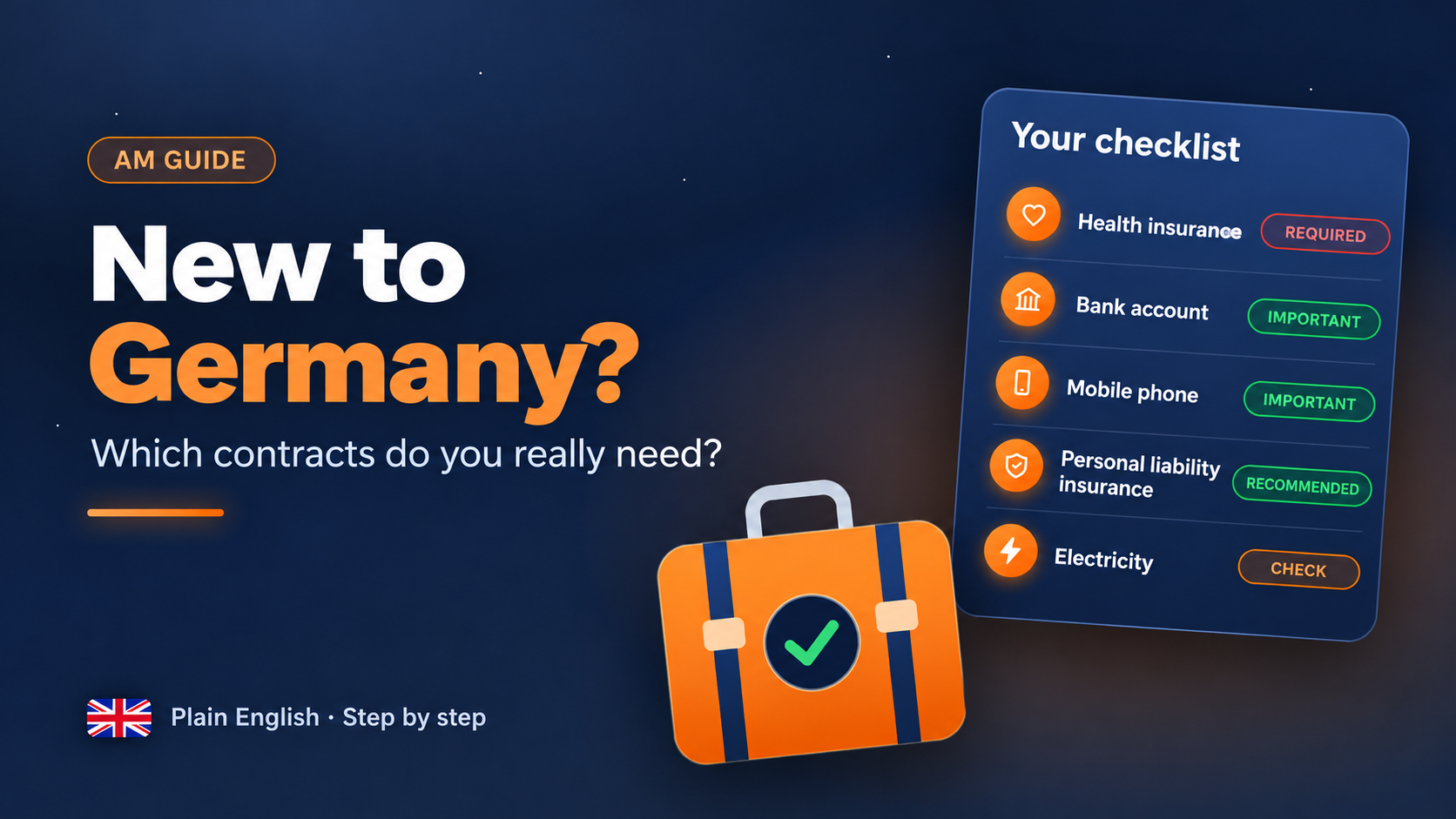
Moving to Germany: the most important points in brief
- Compulsory for everyone: registering your address (Anmeldung) and health insurance (Krankenversicherung). If you have a car, car insurance too. Without citizenship of a European Union country you also need a valid residence permit or visa.
- Without these, almost nothing works: a bank account and a German mobile number.
- Very sensible: liability insurance (Haftpflichtversicherung). It’s cheap and protects you from big debts.
- Careful with long contracts: Many of them run for 24 months. Don’t sign anything you don’t understand.
What do I need in Germany? Your list
Tick what applies to you. The list below changes right away. It shows what is compulsory, what makes sense and what can wait.
We explain how to open an account step by step, in English
Moving to Germany: the first steps in the right order
The order matters. Without registering your address you usually can’t open an account. And without an account you can’t sign a phone or electricity contract.
Registering your address
Within two weeks of moving into your flat, go to the Bürgeramt (in some cities it’s called the Einwohnermeldeamt) and register (Anmeldung). This is required by the Federal Registration Act (section 17). You need your passport and the confirmation from your landlord (Wohnungsgeberbestätigung). There you get the registration certificate (Meldebescheinigung). Keep it safe, you’ll be asked for it often.
Health insurance
It’s compulsory for everyone who lives here. If you work as an employee, you’re usually insured with a public health insurance fund (Krankenkasse). You choose the fund yourself. If you come from a country outside the European Union, you usually also need health insurance for your residence permit.
Bank account
Your salary, rent and almost all contracts go through your account (Girokonto). Anyone who is here legally has the right to open a basic account.
Mobile phone and internet
You need a German number for the bank, work and official offices. To start with, a prepaid SIM card (Prepaid) or a contract you can cancel every month is enough. Your SIM card from a country outside the European Union works in Germany with roaming, and that can be very expensive.
Good to know: After registering your address you’ll get your personal tax number (Steuer-Identifikationsnummer) by post. The letter comes after two to three weeks. Keep it safe, your employer will ask for this number.
Which insurance is compulsory in Germany? 9 contracts in brief
Health insurance
You can’t do without it. If you earn little or don’t work yet, ask the public health insurance fund which way is right for you.
Car insurance
No car goes on the road without liability insurance. Prices vary a lot. Comparing almost always pays off: Car insurance in Germany.
Radio and TV fee
For every flat you pay about 18 euros a month for radio and TV (Rundfunkbeitrag), even if you don’t have a TV. The letter comes by itself. If you receive certain social benefits, you can apply for an exemption. A low income alone isn’t enough.
Liability insurance
If you damage someone else’s property or injure someone, you pay out of your own pocket. That can be very expensive. Liability insurance (Privathaftpflicht) usually costs only a few euros a month. More here: Liability insurance Germany.
Bank account
Many accounts have a monthly fee, some don’t. When you compare, look at the monthly fee and the cash machines near you: Bank account in Germany.
Electricity
In your flat, electricity comes straight away from the local supplier, on the basic tariff (Grundversorgung). It’s often the most expensive. With a comparison you usually find something cheaper: Electricity in Germany. If the flat has its own gas boiler, compare gas too: Gas in Germany.
Mobile phone and internet
Compare both: SIM card in Germany and Internet in Germany. Watch the contract length: if you don’t know where you’ll live, one month is better than 24 months. One more thing: calls from a German number to other countries are not roaming and can cost more.
Household contents insurance
It pays for your belongings after a fire, a burglary or water damage. In German it’s called Hausratversicherung. It makes sense if you have furniture and devices you couldn’t easily buy again. More here: Household insurance Germany.
Everything else
Accident insurance, legal protection, extra dental insurance, savings contracts: you don’t need them at the start. Take your time until you’re properly settled.
Compare first, then decide.
Moving to Germany: 6 mistakes that cost a lot
Signing on the spot in the shop
A contract with a new phone usually runs for 24 months. If you sign it in the shop, you have no right to withdraw from the contract. Take the papers home and read them calmly.
Contracts at the door
If someone knocks on your door and wants to sell you electricity or internet, don’t sign anything. If the contract is already signed, you can withdraw within 14 days. This is stated in the German Civil Code (section 355).
Staying on expensive electricity
If you do nothing, you stay on the basic tariff (Grundversorgung) of the local supplier. You can cancel this contract with two weeks’ notice.
Leaving bills unpaid
Bills you don’t pay even after reminders (Mahnung) can end up with Schufa. Schufa is a company that banks and landlords get information from. A bad entry makes it harder to find a flat and get a loan.
Too many insurance policies
Sellers often offer a whole package. To start with, health insurance, liability insurance and, if you have a car, car insurance are enough.
Forgetting to cancel a contract
Many contracts renew themselves. Write the date down somewhere. With the cancellation letter template (Kündigung) in our free tools the letter is ready in one minute. Explanations in English, the letter in German.
Compare for free. You decide.
Car in Germany: driving licence and insurance
Driving licences from European Union countries are valid in Germany without exchange. Licences from countries outside the European Union, for example from the United Kingdom, the USA or India, are usually only valid for 6 months after you settle in Germany. After that you have to exchange them for a German licence at the driving licence office (Führerscheinstelle). Ask your city’s office first what exactly applies to you.
With car insurance, anyone without claim-free years in Germany pays more at the start. Some insurers recognise claim-free years from abroad if you have a certificate from your previous insurer, others don’t. Be sure to ask about this, it can save you a lot of money.
Free and without obligation
Comparison calculators in German: this makes it easier
Our partners’ comparison calculators are currently only in German. Turn on the translation in your phone’s browser and the page will appear in English. On each topic’s English page we explain the words in the form one by one. These are asked most often: Postleitzahl (postcode), Geburtsdatum (date of birth), Verbrauch (consumption) and Laufzeit (contract length).
Moving to Germany: frequently asked questions
Living in Germany: what are the first steps?
If you’re not a European Union citizen, you need a visa or a residence permit. Within two weeks of moving into your flat, register at the office (Anmeldung). Then sort out health insurance and open a bank account. After that, get a German mobile number and check the electricity in the flat. Liability insurance makes a lot of sense, the others can wait. You find the order and the checklist on this page.
Moving to Germany: which insurance is compulsory?
Health insurance for everyone. If you have a car, car liability insurance. In some federal states liability insurance for dogs is also compulsory. All other insurance is voluntary.
Moving to Germany: do I need a visa or a residence permit?
That depends on your citizenship. Citizens of European Union countries can live and work in Germany without a visa and without a residence permit. Everyone else usually needs a visa or a residence permit. The United Kingdom has not been part of the European Union since 2020. The foreigners’ office (Ausländerbehörde) or an advice centre for migrants can explain the details.
Can I open a bank account in Germany right after arriving?
Yes, even if you don’t have a job. You usually need your passport and the registration certificate (Meldebescheinigung), and without European Union citizenship often also your residence permit. Anyone who is legally in the European Union has the right to a basic account, even without a permanent address. This is stated in the Payment Accounts Act (section 31). Many people open their account on their phone, with video verification. If video verification doesn’t work, you can do it at the post office (PostIdent).
What is Schufa?
It’s a company that records whether people pay their bills and loans. Banks, landlords and phone companies get information from it. If you’ve just arrived, you don’t have any entry yet. That’s not a bad thing, but some companies are more careful then.
Moving to Germany: can I get a loan?
At the start it’s difficult. Banks usually want a regular income, an employment contract after the probation period, a permanent address in Germany and a German bank account. Without European Union citizenship many banks also look at your residence permit. If you have all of this, you can compare here: Loan in Germany. Don’t take out a loan if you’re not sure you can pay it back.
Do I really need liability insurance?
It isn’t compulsory, but in Germany almost everyone has it. If you cause someone damage, you pay for all of it, even if it happened by accident. With injuries the amounts can be very high.
Are my children and my husband or wife insured?
With the public health insurance fund, children and a husband or wife without their own income are usually insured with you for free. With liability insurance there are tariffs for the whole family.
How do I get out of a contract?
By cancelling in writing, so by letter or by email. Contracts made online can also be cancelled right there. After the first contract period ends, most contracts can be cancelled with one month’s notice.
What do I do if I don’t understand a letter?
Don’t put it aside. Many letters have a deadline. Ask someone who speaks good German, or go to an advice centre for migrants or to the consumer advice centre (Verbraucherzentrale). The first help there is often free or cheap.
Does the comparison cost anything?
No. The comparison is free for you. If you sign a contract through our partners, we may receive a commission. The price for you doesn’t change.
Start with the most important things
First the bank account, then the phone, then liability insurance. Compare calmly. You decide. You don’t have to sign anything right away.
Compare bank accountsFree, without obligation and in a few minutes
This will help you too
These pages help everyone who has just arrived in Germany in their first days.
Please note: AM Finanzvergleich gives general information and comparison options. We are neither advisers nor brokers. We don’t give personal advice on insurance, finance, tax and legal matters, or on residence, work or state benefits. The information on this page is simplified and may change. What applies to you depends on your situation. If you sign a paid contract through a comparison or a partner link on this page, we may receive a commission. There are no extra costs for you.